
Projected vs Actual Dakota County Release Dates
A projected date is a present calculation, not an appointment. Minnesota DOC uses the exact public field label Anticipated Release Date. That date reflects the information in the state sentence record when the Locator was updated. An actual prison release begins the next phase of the sentence, often supervised release in the community. Final discharge is later and ends DOC jurisdiction over that sentence. Those events should not be collapsed into one “release date.”
Dakota County Jail has a separate release process. A pretrial detainee does not have a fixed sentence-based date. Bail, a bond, a court order, dismissal, a warrant, or transfer can determine the next custody event. Someone serving a local jail sentence may have an expected end date, but staff must verify the court authority, good-time adjustments, identity, and any warrant or detention order before processing. The retained jail transaction establishes the actual date and time. A court disposition date establishes a judicial event and may not match the time the person left the building.
Find Dakota County Projected Release Dates
Start with the last known custodian. Dakota County’s current jail search covers only people still held there, while the Minnesota DOC Locator covers people committed to the Commissioner who remain under DOC jurisdiction. Court records explain the sentence and later changes. A federal sentence requires federal sources. Choosing the wrong database can create a confident but false answer.
- Identify whether the person is awaiting court, serving a Dakota County jail term, or serving a Minnesota state-prison sentence.
- For a state prisoner, search the Minnesota DOC Locator by the six-digit MNDOC Offender ID when known, or by full name.
- Open the matching record and read the exact “Anticipated Release Date,” status, sentence, and expiration fields shown.
- For a county-jail sentence, review the Dakota County court register and ask Jail Information or Sheriff’s records for the calculated and actual date.
- Check the court case for sentence amendments, custody credit, warrants, revocation, or another order that affects custody.
- Confirm the date with the custodian close to release. Do not rely on calendar arithmetic alone.
The Dakota County released-inmate record path gives the full follow-up when a person is no longer in a current roster. A release transaction can also record a transfer to DOC, ICE, USMS, or another jail instead of return to the community.
Note: Search by an agency identifier when possible, then compare the court file and sentence before accepting a same-name result.
Minnesota DOC Anticipated Release Date
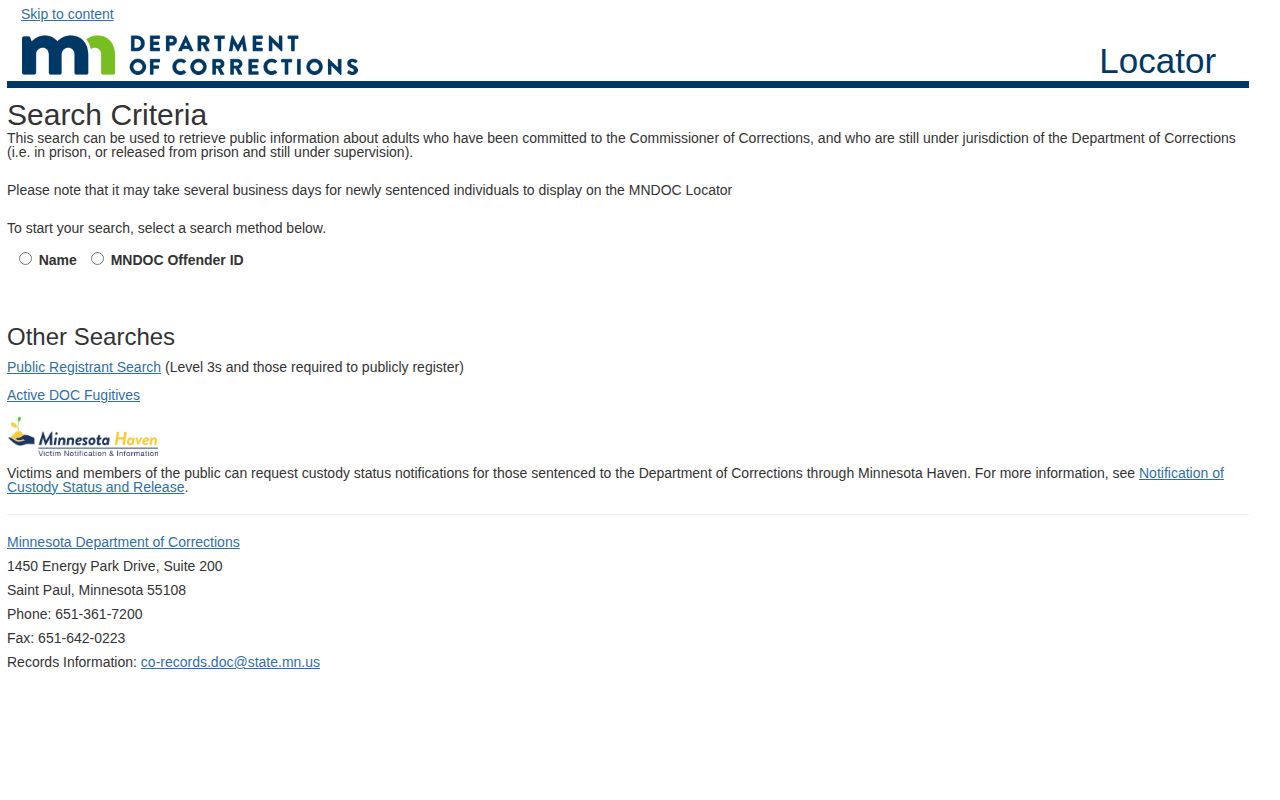
The Minnesota DOC Locator is the main public source for a state-prison estimate. It includes people confined in prison and people released from prison who remain under supervision. A result may show “Under Supervision as of” followed by the displayed date after confinement ends. That phrase is evidence of a state-prison release into supervision, not final discharge. The Locator does not cover a person whose only confinement was at Dakota County Jail, and it is not a full archive of every person whose DOC jurisdiction has ended.
Search with the MNDOC Offender ID when available. A name search can include aliases or a current DOC name that differs from the queried name. Match the birth date, court file, sentence date, offense, and identifier. A newly sentenced person can take several business days to appear. If a fully discharged person no longer returns, the Dakota County sentencing case and a public DOC records request are more durable sources.
The official DOC Locator record shows the live sentence and release labels used for a Dakota County state-prison case.
For a detailed computation, contact Minnesota DOC Records Management at 651-361-7330 or CO-Records.DOC@state.mn.us. Ask for the current calculation and the public records that support it. DOC is not required to create a custom calculation that it does not maintain.
Dakota County Sentences and Good Time
Minnesota’s ordinary fixed felony framework is not an 85-percent rule. For covered offenses committed on or after August 1, 1993, Minn. Stat. § 244.101 divides the executed sentence into a two-thirds minimum imprisonment term and a one-third maximum supervised-release term. An executed sentence is a term the court has ordered to be served, as opposed to a stayed term that is held back while conditions are met.
A basic example shows the framework without predicting one person’s date. A 36-month executed sentence begins with a 24-month statutory imprisonment component and a 12-month supervised-release component. Case-specific rules still apply. Jail credit, consecutive sentences, discipline, conditional-release terms, later court orders, and earned incentive release credit can change the calculation. Supervised release is the community portion of the prison sentence under DOC jurisdiction. It is not final discharge.
The Minnesota Rehabilitation and Reinvestment Act in Minn. Stat. §§ 244.40 through 244.47 permits earned incentive release credit for eligible people who meet individual plan goals. Section 244.44 caps the credit at 17 percent of the total executed sentence and does not permit confinement to fall below half of that sentence. Not every person qualifies, and the maximum is not automatic. Credit may be revoked for specified misconduct. Discipline or refusal of a required program may add confinement under the governing rules.
- Anticipated Release Date
- The current Minnesota DOC estimate shown in the public offender record.
- Supervised release
- The community portion of a state-prison sentence while DOC jurisdiction continues.
- Final discharge
- The end of DOC jurisdiction over the sentence, distinct from leaving prison.
- Jail credit
- Court-recognized prior custody time applied to the sentence calculation.
Dakota County jail sentences use the local jail’s calculation and the court’s sentence, not the DOC Locator. The county Custody Manual directs staff to verify good-time adjustments immediately before release and to check warrants, detention orders, and authorizing paperwork. Dakota County has not published a public calculator, so the jail record is the reliable local source.
Factors Changing Dakota County Release Dates
A release estimate can move for lawful reasons after it first appears. Some factors change the confinement calculation. Others prevent release to the community even though one sentence or custody episode has ended. The current agency record should control over a date derived by counting from sentencing.
| Factor | Effect on the Date | Best Record |
|---|---|---|
| Earned incentive credit | May shorten eligible state confinement within statutory limits. | DOC calculation and record |
| Disciplinary confinement | May delay release after misconduct or a required-program refusal. | DOC sentence computation |
| Jail or custody credit | Applies qualifying prior custody time as ordered by the court. | Sentencing order and register |
| Consecutive sentences | Changes when one sentence component starts after another. | Court and DOC records |
| Warrant or detainer | May cause transfer to another agency instead of community release. | Jail release destination and agency record |
| Sentence amendment | Changes the legal term or credit used in the computation. | Later court order |
| Board action | Can set or continue review in the limited cases under board authority. | Approved board minutes |
Most modern determinate Minnesota cases do not receive routine parole-board release hearings. The Minnesota Supervised Release Board serves narrower groups, including eligible life sentences, old indeterminate sentences, and specified long juvenile sentences. A hearing or review date is not a promise of release. The board may assign a projected date or continue a case with directions. Approved minutes are the official public result trail.
Note: A Dakota County roster disappearance may mark release, transfer, identity correction, or a data change, so it cannot settle the release date.
Dakota County Weekend Release Date Rule
Minnesota has a distinctive calendar rule that can defeat simple date math. Under Minn. Stat. § 244.05, subdivision 1a, the direction of the adjustment turns on the offense date. For an offense committed on or after August 1, 1992, a scheduled release that falls on Friday, Saturday, Sunday, or a holiday moves forward to the first following day that is not one of those days. For an older offense, the date moves back to the last preceding eligible day.
This rule is separate from earned credit and discipline. A date can therefore change even after the sentence term has been computed correctly. The adjustment also shows why a family pickup plan should follow the live custodian’s confirmed date rather than an independent count from the sentencing day. Other case facts can still intervene, including a detainer, a court order, or a later change in the sentence record.
County-jail release timing remains distinct. Dakota County says most jail releases occur about 5 a.m. unless a court order gives another time. That is an operational norm, not a computed state-prison date or a guarantee for one person. Counts, shift changes, identity checks, warrants, paperwork, and safety conditions can affect processing.
Dakota County Court Release Records
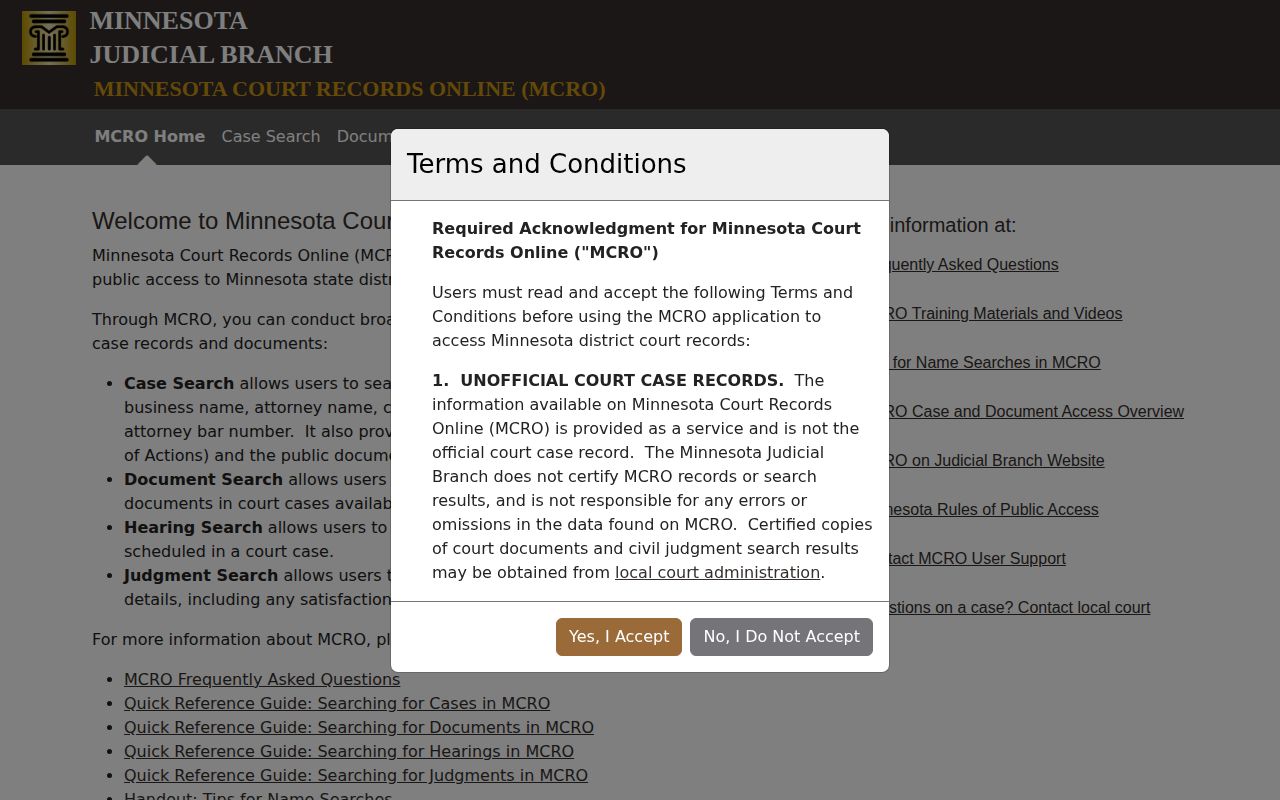
Minnesota Court Records Online, or MCRO, provides the legal foundation for a Dakota County release-date inquiry. Search by case number when possible, narrow a person search to Dakota County and the criminal case type, then open Case Details and the Register of Actions. Review the sentence, custody credit, executed or stayed term, release or bail order, warrant events, revocation, and later discharge. “Stayed execution” does not create a prison release date because the term is not being carried out while the stay remains in effect.
The official MCRO source shows the search path and public access conditions used for a Dakota County sentence record.
Remote documents have limits. Older or excluded material may require a courthouse terminal or counter request. Dakota County District Court has locations in Hastings, Apple Valley, and West St. Paul. Ask for a named sentencing, amendment, release, or discharge document tied to the case number rather than a broad “inmate record.” A court order states legal authority, but it does not always show the minute jail staff finished release processing.
Confirm Dakota County Release Dates
Close to the expected date, confirm with the agency that has custody. For Dakota County Jail, call Jail Information at 651-438-4800 and request the public release transaction from Sheriff’s records when a past actual time is needed. For state custody, use the live DOC record and contact Records Management for the computation. If a detainer or transfer appears, check the receiving agency rather than describing the person as released to the community.
Notification is a separate task. Minnesota VINE covers Dakota County Jail events, while Minnesota Haven handles DOC cases. The Dakota County VINE inmate check explains how to match a county record and register for a custody-change alert. An alert can report an event, but it does not replace the court order or release transaction.
A sound release date lookup therefore joins three records: the court’s sentence and orders, the custodian’s current calculation, and the final transaction. When they differ, record the source and time of each entry and ask the responsible office to explain the public calculation. That is safer than choosing the earliest date or assuming an old estimate remained fixed.
Note: Final discharge, release from confinement, and release from Dakota County Jail are separate events that can carry different dates.
Public Record Search
Sponsored Results